
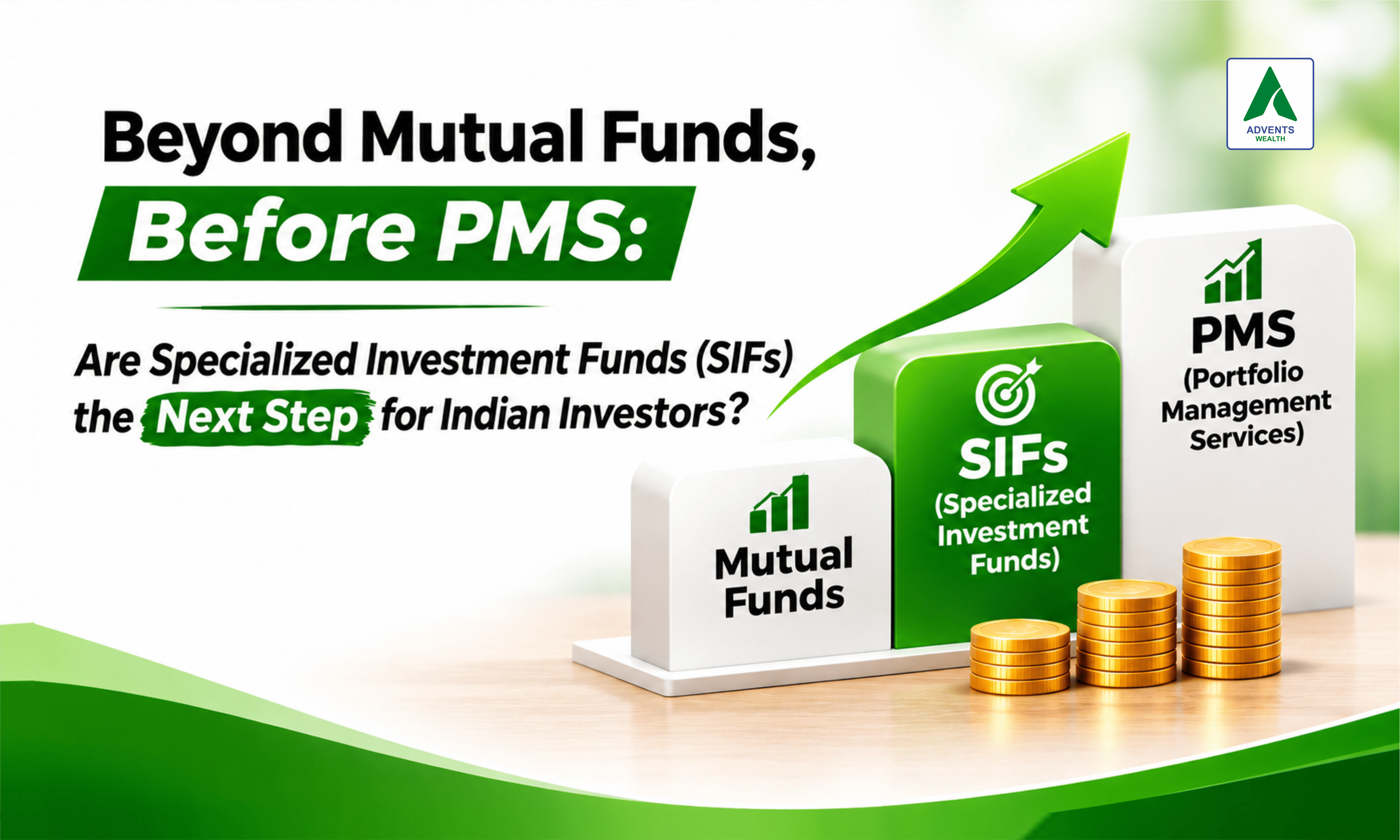
What if your investment strategy could do more than simply participate in rising markets? Specialized Investment Funds bring more flexible investment strategies to experienced investors—but are they suitable for your portfolio?
For years, investors in India had two familiar choices. Traditional mutual funds offered accessible, professionally managed investments, while Portfolio Management Services (PMS) provided more customised strategies but came with a significantly higher entry requirement.
Investors looking for something between these two options had limited choices.
That is where Specialized Investment Funds (SIFs) enter the picture. Introduced under SEBI's regulatory framework in 2025, SIFs aim to bridge the gap between conventional mutual funds and PMS by offering differentiated investment strategies within a regulated, pooled investment structure.
But greater flexibility also means greater complexity.
What Are Specialized Investment Funds (SIFs)?
A Specialized Investment Fund (SIF) is an investment product offered by eligible mutual fund houses. It allows fund managers to use certain advanced strategies that go beyond the conventional approach followed by many mutual fund schemes.
One important feature is the ability to use derivatives for hedging, portfolio rebalancing and, within prescribed limits, unhedged short exposure of up to 25% of the strategy's net assets.
In simple terms, a traditional long-only equity fund generally benefits when its investments appreciate. An eligible long-short SIF strategy can also take permitted short positions through derivatives, potentially helping the manager respond to falling prices or manage portfolio risk.
However, this does not mean an SIF will automatically protect your money during a market correction. Derivatives introduce additional risks, and outcomes depend on the strategy and the fund manager's decisions.
SIF vs Mutual Funds vs PMS: What's Different?
| Feature | Mutual Funds | SIFs | PMS |
|---|---|---|---|
| Minimum investment | Scheme-specific; often accessible from small amounts | ₹10 lakh aggregate SIF investment threshold | Generally ₹50 lakh |
| Structure | Pooled investment | Pooled investment | Individual client portfolio |
| Investment approach | Conventional and scheme-specific strategies | More specialised strategies, including permitted long-short approaches | Strategy depends on the PMS |
| Portfolio ownership | Units in a scheme | Units in an investment strategy | Securities held in the client's portfolio |
| Liquidity | Depends on scheme type | Depends on strategy terms | As per PMS agreement |
SIFs offer a different investment approach, not a guaranteed improvement over mutual funds or PMS.
Four Things to Understand Before Investing in an SIF
1. The ₹10 Lakh Investment Threshold
SEBI requires an aggregate investment of at least ₹10 lakh across SIF investment strategies at the investor's PAN level. This is not a separate ₹10 lakh requirement for every strategy. Investments in regular mutual fund schemes of the same fund house do not count towards this threshold. Accredited investors are exempt, subject to applicable rules.
2. Understand the Risk of Derivatives
SIF strategies may use derivatives for hedging and short exposure. While these tools can help manage certain market risks, they can also increase complexity and potential losses. Never choose a strategy simply because it promises to perform differently from the market.
3. Liquidity Depends on the Strategy
Not every SIF offers the same redemption facility. Some strategies may have specific transaction windows or notice periods of up to 15 working days. Check the Investment Strategy Information Document (ISID) before investing. An SIF should not replace your emergency fund.
4. Taxation Needs a Closer Look
Do not automatically assume every SIF receives identical tax treatment. The applicable tax rules depend on the strategy's structure and tax classification. Understand the potential tax impact before investing or redeeming.
Should You Add an SIF to Your Portfolio?
An SIF is not a replacement for your existing mutual fund investments. It may be considered as a specialised allocation for investors who have already established their core financial goals, understand market-linked risks and can evaluate more complex investment strategies.
Before investing, assess your risk appetite, investment horizon, liquidity requirements and the role the SIF will play in your overall asset allocation.
At Advents Wealth, we believe investment decisions should begin with your financial goals—not the popularity of a new product. If you are exploring SIFs, understand the strategy first and then evaluate whether it belongs in your portfolio.
Explore Specialized Investment Funds with Greater Clarity
Considering an SIF but unsure whether it fits your investment strategy?
Connect with Advents Wealth, an AMFI-registered Mutual Fund Distributor, to understand available SIF strategies, risk bands, investment requirements and liquidity conditions before making a decision.
Call us: 98927 10118
Website: https://adventswealth.com/
Make informed investment decisions with clarity, discipline and a goal-oriented approach.
Mutual Fund and SIF investments are subject to market risks. Read all scheme-related and strategy-related documents carefully. Past performance is not indicative of future returns. There is no assurance or guarantee of returns.
Have questions on this topic?
Our wealth advisors can guide you based on your exact financial situation.